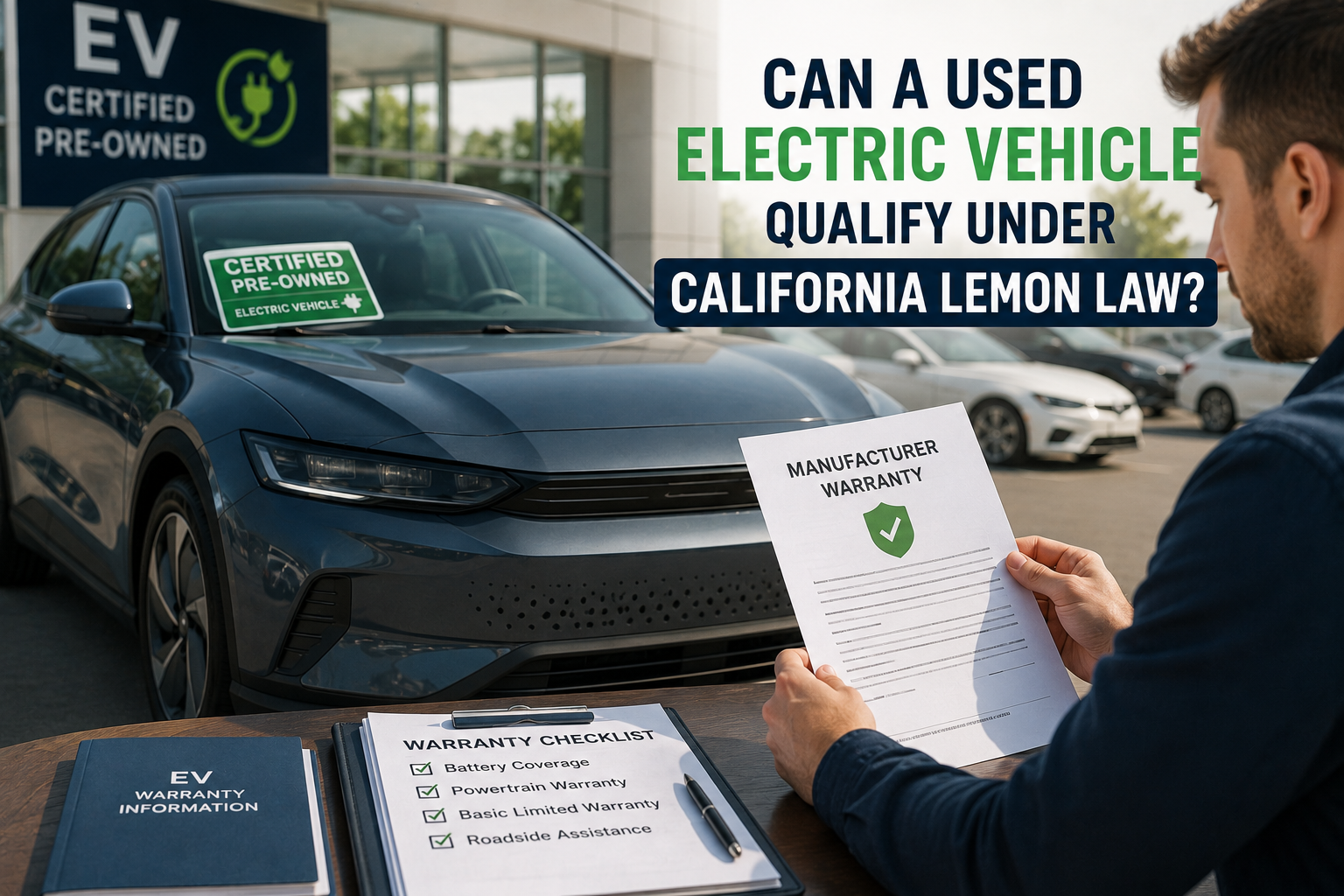

California lemon law remains an important protection for people dealing with defective cars and EVs. What has changed is the procedure around some claims. If your vehicle keeps returning to the dealer for the same problem, it helps to understand how written notice, repair history, and manufacturer response timelines may affect your next steps.
Recent updates tied to AB 1755 and SB 26 have added new procedural rules for certain manufacturers in California. For drivers, that means the process may involve more formal notice requirements before a lawsuit, more structured timelines, and more attention to documentation from the very beginning. These changes do not eliminate your rights, but they do make it more important to handle the early stages of a claim carefully.
If you are still trying to figure out whether your vehicle may qualify as a lemon, start with Signs You May Have a Lemon Car and What to Do About It.
Why California’s Lemon Law Process Is Getting More Attention
 California has long had strong consumer warranty protections, but lawmakers and agencies have recently focused on procedure and dispute resolution. That matters because many drivers assume lemon law claims only depend on how many times the car was repaired. In reality, the process may also depend on what notice was given, how the manufacturer responds, and whether the vehicle owner has preserved the right records.
These updates have become especially relevant as more claims involve electric vehicles, software-related defects, charging problems, and repeated warning messages that may not fit the old picture of a broken engine or transmission. A modern lemon claim may involve a vehicle that technically runs but still has recurring issues that affect safety, use, or value.
What Drivers Should Know About the New Procedures
Written Notice May Matter More Than Before
One of the biggest practical takeaways is that written notice can play a larger role in some California lemon law disputes. Instead of waiting until frustration builds, drivers should consider documenting the defect clearly and creating a paper trail early. That includes reporting the same issue consistently, saving dealer communications, and keeping copies of every repair order.
If your vehicle continues to have the same defect, sending a written demand for repurchase or replacement may become an important step depending on the manufacturer and the procedure that applies. A casual phone call is rarely enough. Written notice creates a timeline and can help show that the manufacturer had an opportunity to respond.
Manufacturer Response Timelines Can Affect Strategy
Updated procedures have also increased attention on response deadlines. If a manufacturer receives proper notice, timing may matter for settlement discussions, restitution, replacement offers, and what happens next if the matter is not resolved. That is one reason many drivers benefit from organizing their claim before sending any demand.
Even when a defect is serious, a poorly documented process can slow things down. A strong file usually includes repair invoices, warranty records, dates the car was out of service, photos or videos of warning messages, and a clear summary of how the problem affects the vehicle.
Repair Attempts Still Matter
 Although procedures are evolving, repair attempts are still central to most lemon law claims. A vehicle generally needs to show a meaningful pattern of failed repairs, especially when the same defect keeps coming back. Safety-related problems may require fewer attempts than less serious issues, but the key point is that the manufacturer or authorized dealer had a fair chance to fix the defect and did not resolve it.
This is why service visits should always be documented carefully. If you report a stalling issue, battery failure, charging interruption, braking defect, or software malfunction, make sure the repair order describes that exact complaint. Generic language can weaken your file later. If the dealer says the issue could not be duplicated, ask for that statement in writing too.
For a broader overview of how claims are usually built, see The Step-by-Step Process for Filing a Lemon Law Claim.
How These Changes Affect EV Owners
Electric vehicle owners may feel these procedure changes more directly because EV defects can be harder to explain and prove. A charging failure, software freeze, reduced-power warning, phantom battery drain, or over-the-air update issue may not always leave behind a simple mechanical diagnosis. That makes documentation even more important.
For EV claims, drivers should keep screenshots from apps, charging logs, warning messages, range-loss patterns, and service notes. If the car spends days or weeks at the dealership waiting on parts, software review, or battery inspection, track every day it is unavailable. Time out of service can be an important part of the overall story.
Software Fixes Do Not Always End the Problem
Some drivers are told that a software update solved the issue, only for the same defect to return later. That does not automatically end a possible claim. If the same underlying problem keeps affecting the vehicle after repeated attempts to correct it, the overall repair history still matters.
What to Do Before You Escalate a Claim
1. Gather Every Repair Order
Collect every invoice, service record, work order, and dealership note related to the defect. Put them in date order. This helps show how often the issue occurred and what the dealer did each time.
2. Review the Warranty Coverage
Confirm whether the defect arose while the vehicle was under the manufacturer’s warranty. Warranty status often shapes whether a claim moves forward.
3. Create a Written Timeline
Write down when the issue first started, how often it happened, what symptoms appeared, and how the dealership responded. Keep the wording simple and factual.
4. Preserve Emails and Messages
Save texts, emails, appointment confirmations, and any written denial or explanation from the manufacturer or dealership.
5. Check for Recalls
A recall does not automatically make a vehicle a lemon, but it may still help explain the broader defect history. You can look up your VIN through the NHTSA recall tool.
What Happens if the Manufacturer Pushes Back
Manufacturers may argue that the defect is minor, intermittent, outside warranty coverage, or not repaired enough times to qualify. They may also rely on missing paperwork or vague service records to dispute the claim. That is why the strength of your documentation matters so much under a more procedural system.
If your claim has already been challenged, read What To Do When Your Manufacturer Denies Your Lemon Law Claim. It pairs well with this topic because denial issues often become more important when timing, written notice, and procedure are under closer scrutiny.
Possible Paths Toward Resolution
 Depending on the facts, a California lemon law dispute may end in restitution, replacement, settlement, arbitration, or litigation. The right path depends on the manufacturer’s response, the repair history, the severity of the defect, and whether the required steps were followed early in the process.
Some disputes resolve after notice and negotiation. Others move further because the manufacturer disputes liability or delays a meaningful response. Either way, organized records give you a stronger position.
Common Mistakes to Avoid
Waiting Too Long to Organize Records
Many drivers only start gathering documents after a denial. By then, key details may be missing.
Using Inconsistent Language
Describe the same defect consistently from visit to visit. If one repair order says “charging failure” and another says “vehicle would not start,” the record may look less clear unless both describe the same problem.
Assuming a Recall Replaces a Claim
A recall and a lemon law case are not the same thing. Some recalled vehicles are repaired successfully. Others continue to have major problems even after attempted fixes.
Ignoring Warranty Timing
Even a strong defect claim becomes harder when drivers wait too long to act or fail to preserve proof that the issue arose during warranty coverage.
Final Thoughts
California’s newer lemon law procedures do not erase consumer protections, but they do make process more important. Drivers with defective cars and EVs may need to think earlier about written notice, response timelines, and documentation. The more organized your file is, the easier it may be to evaluate your legal options and move the claim forward.
If your vehicle keeps returning for the same defect and the problem still is not fixed, reviewing the claim process early may save time and frustration later. Clear records, consistent repair history, and timely action are often what separate a confusing case from a stronger one.
For more background, you can also review official California information through the California Department of Consumer Affairs, the legislative materials for AB 1755 and SB 26, and general court information through California Courts Self-Help.